IT Security
Risk-Based Vulnerability Management: How to Turn Findings into the Right Priorities
September 30, 2026, Robert Klinger


In modern IT operations, it is no longer sufficient to prioritize vulnerabilities based solely on CVSS scores. Risk-based vulnerability management combines technical severity with the threat landscape, endpoint context, and business relevance. This transforms long CVE lists into concrete remediation measures.
Risk-Based Vulnerability Management – In a Nutshell
- A high CVSS score reflects the technical severity, but not necessarily the actual risk to your organization.
- The context of the affected software and endpoints determines the priority of a vulnerability.
- Prioritization leads to specific actions, such as updates, installations, and uninstallations
- The baramundi Proactive Hub links vulnerability information to the status of your own IT environment.
A dashboard doesn’t protect you. Taking action does. That’s how the previous post on auto-remediation (opens in new tab) began. But before an IT department can take action, it must decide where to start.
In vulnerability management, this is often more complex than expected. Scanners and security databases constantly provide new indications of vulnerabilities. Even a single outdated application can generate numerous CVE entries. The list grows, but the time available does not.
And the pressure is mounting. The Mandiant M-Trends 2026 Report (opens in new tab) now estimates the median time to exploitation of a vulnerability at minus seven days. This means vulnerabilities are regularly exploited before a patch is even available.
Why Traditional Vulnerability Risk Management Has Its Limits
Vulnerability management systems usually follow a simple principle: Critical vulnerabilities are listed first, followed by high, medium, and low ratings. This provides an initial classification, but it is not a triage system sufficient for day-to-day operations.
This is because a vulnerability with a (opens in new tab) high CVSS (Common Vulnerability Scoring System) score (opens in new tab) might affect an application installed on only three isolated test devices. Meanwhile, another vulnerability might have a lower technical severity rating but be present in a browser on nearly all endpoints. There may even already be a known exploit for it, or the affected devices may be used by employees with extensive permissions.
To establish a reliable priority, IT therefore needs additional information:
- Which software versions are actually installed?
- How many and which endpoints are affected?
- Is there any evidence of current exploitation?
- Which devices or user groups are particularly at risk?
- How time-consuming and risky would the remediation be?
Depending on the answers, the order in which they need to be addressed may change significantly.
From Individual CVEs to Security Vulnerability Remediation
CVE entries describe individual known vulnerabilities. However, administrators rarely work at this level. They deploy a software update, change a configuration, or install/uninstall an application.
An old software version may contain ten or twenty CVEs. In a traditional list, this results in ten or twenty findings. However, a single update may be sufficient to resolve the issue.
That’s why it makes sense to shift the focus from individual CVEs to the affected application and the possible corrective action. This allows multiple findings to be consolidated into a single, concrete task.
This does not artificially reduce the number of entries. It simply makes their significance clearer. An administrator can identify which application is causing the risk, where it occurs, and how many vulnerabilities can be eliminated with a single action.
What is risk-based vulnerability management (RBVM)?
Risk-Based Vulnerability Management (RBVM) goes beyond simply assessing vulnerabilities based on their technical severity. Instead of considering each vulnerability in isolation, the threat landscape, affected systems, and business context are all taken into account when prioritizing vulnerabilities.
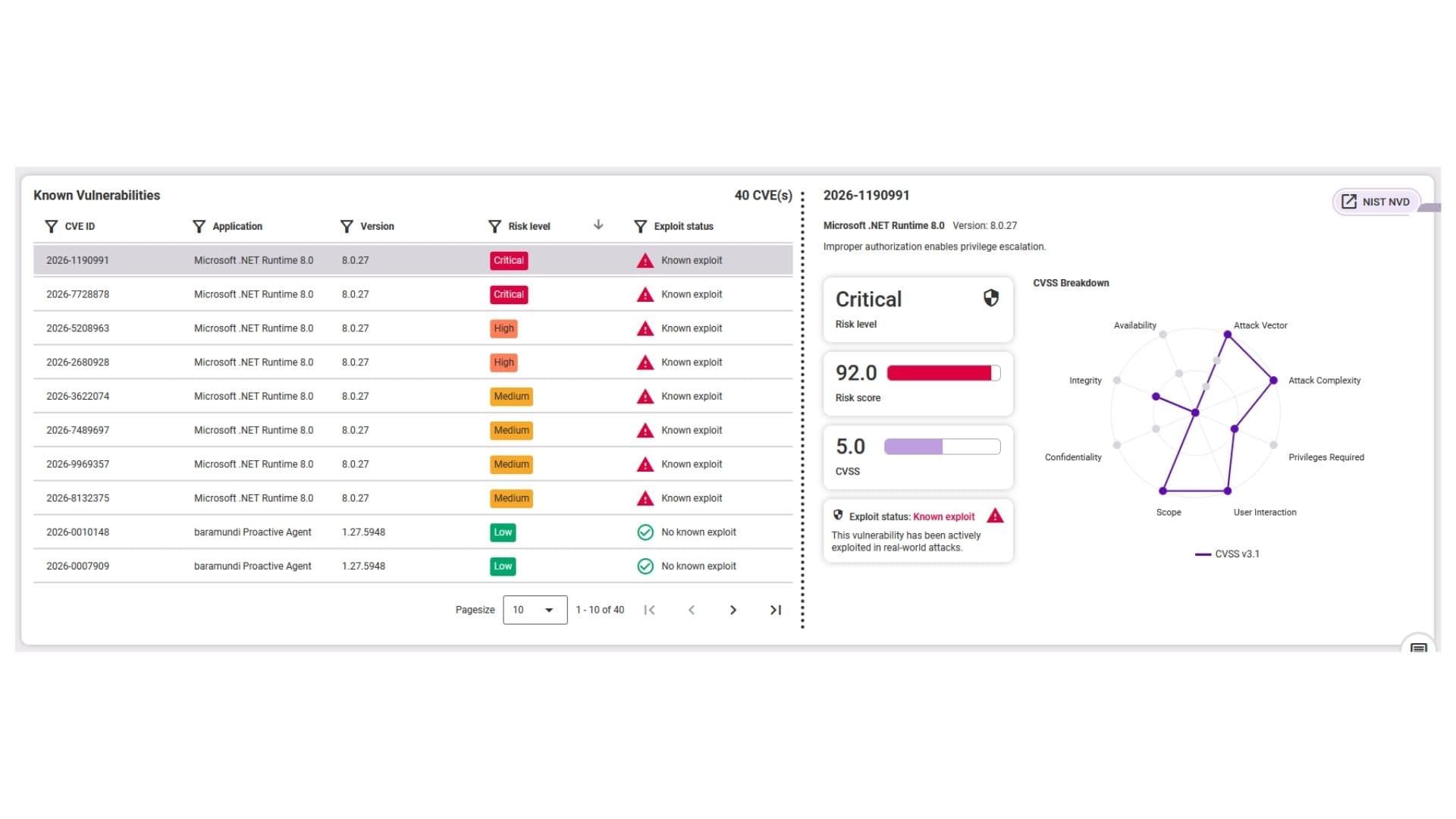
A sensible approach is to first cross-reference the identified applications and versions with the actual affected version ranges of a CVE. The relevant vulnerabilities are then enriched with current threat intelligence.
This includes
- the technical severity,
- known exploits,
- a forecast of how likely future exploitation is,
- and the context of the respective IT environment (e.g., test or business-critical system).
This results in a more accurate assessment than the CVSS score alone.
This approach becomes even more useful when this assessment is subsequently linked to data from the affected endpoints. The administrator can then see which application and version are affected, on which devices they are present, and how urgent the need for action is in their own environment.
Prioritizing Vulnerabilities—and Then What? How Security Insights Lead to a Stable IT Infrastructure
Setting a clear priority is the first step. But it’s taking the right action that makes the difference. In our best practice guide, “DEX & Unified Endpoint Management (UEM)—Practical IT Knowledge for IT,” we show how to turn vulnerable software environments into secure and higher-performing endpoints.
Not every risk requires the same remediation
Even a high priority does not necessarily indicate how a vulnerability should be addressed.
A browser or PDF reader can usually be updated quickly and across a wide range of devices. With business-critical software, however, interfaces, extensions, or other dependencies may be affected. An immediate rollout to all endpoints could potentially cause new disruptions and “digital friction.” (opens in new tab)
For standard software, a largely automated update may be appropriate. Critical applications are first updated on selected devices. Only when no new issues arise is the next group of endpoints updated.
This approach ensures that even an urgent security measure remains manageable. The technical assessment indicates how quickly IT should respond. The endpoint and application context help determine the appropriate course of action.
"Why shouldn't vulnerabilities be viewed solely from a security perspective?"
Robert Klinger (Product Manager): “Because this often manifests itself in the same application. Outdated software runs on many endpoints, is hardly used anymore, but still causes CPU load and introduces known vulnerabilities. Someone focused solely on security would simply update everything. With endpoint context, the approach becomes more targeted: Active devices receive the secure version, while unused installations are removed. Here, security and the digital employee experience view the same application from different perspectives. The baramundi Proactive Hub consolidates this information in one place.”
Conclusion: From Priority to Security Vulnerability Remediation
So a long list of open CVEs doesn’t necessarily tell an IT team where to start. Only when vulnerabilities are linked to the actual state of the organization’s IT environment does a general security finding become a concrete, meaningful action.
Every remediation is followed by verification: Was the vulnerable version actually replaced? Are there still devices affected? Did the update cause new problems?
The baramundi Proactive Hub (opens in new tab) supports IT teams in doing exactly that: vulnerabilities are cross-referenced with existing endpoints, assessed for relevance, and consolidated into specific remediation actions.
Categories: IT Security