Management Suite|Endpoint Management
Green IT: Intelligent Endpoint Management as a Driver of Sustainability
September 21, 2026, Benedict Weidinger
Many people still view Green IT as purely a sustainability issue. But there is much more to it than that. Rising energy prices, new reporting requirements such as the CSRD, and the desire for more stable IT environments have long since made Green IT a business necessity.
Green IT: At a Glance
- Green IT refers to all measures taken to operate IT systems in a resource-efficient manner throughout their entire life cycle, from procurement to disposal.
- Key Green IT measures include energy management, extending hardware lifespan, remote management, and comprehensive inventory tracking.
- Endpoint management makes Green IT scalable, automatable, and measurable across any number of devices.
- Green IT is not merely a sustainability issue; it directly contributes to cost savings and operational stability.
What is Green IT?
Green IT refers to all measures aimed at operating information and communication technology in a resource-efficient manner throughout its entire life cycle—from manufacturing and procurement through use to recycling and disposal. This definition of Green IT encompasses not only energy savings but also efficient resource use, durable hardware, and software that is as streamlined as possible.
In practice, this means that IT should be operated in a way that fulfills its purpose without creating an unnecessary burden—whether technical, environmental, or economic. Especially in established IT landscapes, inefficiencies often creep in gradually—for example, through unused devices, bloated software, or a lack of transparency regarding actual resource consumption. Green IT addresses precisely these issues and lays the foundation for well-informed decisions in IT operations.
For companies, this is not just an environmental issue. (opens in new tab) Rising energy and hardware costs, reporting requirements (e.g., CSRD), and the pressure to increase efficiency make Green IT a clear business priority.
Energy Management: Leverage During Operations
A particularly tangible starting point for Green IT measures is the energy consumption of end devices in everyday use (opens in new tab). In many environments, client devices continue to run outside of working hours or use inefficient default settings. This is exactly where structured energy management comes into play—ideally controlled centrally via an endpoint management solution (opens in new tab).
Typical Green IT measures in everyday use include:
- Energy consumption transparency: IT managers can identify which devices or groups of devices consume a particularly large amount of energy and where there is potential for optimization
- Automated energy-saving profiles: Instead of static defaults, profiles are adapted to actual usage times, for example, depending on the department or work model
- Scheduled shutdown: Devices are automatically shut down or switched to defined power-saving modes outside of usage hours
- Monitoring and reporting: Savings can be tracked and used as key metrics for internal optimizations or external reports (e.g., CSRD)
The effect is technically measurable and economically significant. A company with several hundred or thousand end devices can save substantial electricity costs annually through consistent power management. At the same time, hardware wear and tear is reduced, which indirectly extends the devices’ lifespan.
Without appropriate Green IT measures, however, ongoing idle costs arise that often go unnoticed. Furthermore, there is no data foundation to reliably demonstrate savings or improvements to internal or external stakeholders.
What Green IT Measures Are Available? The Lifecycle Approach
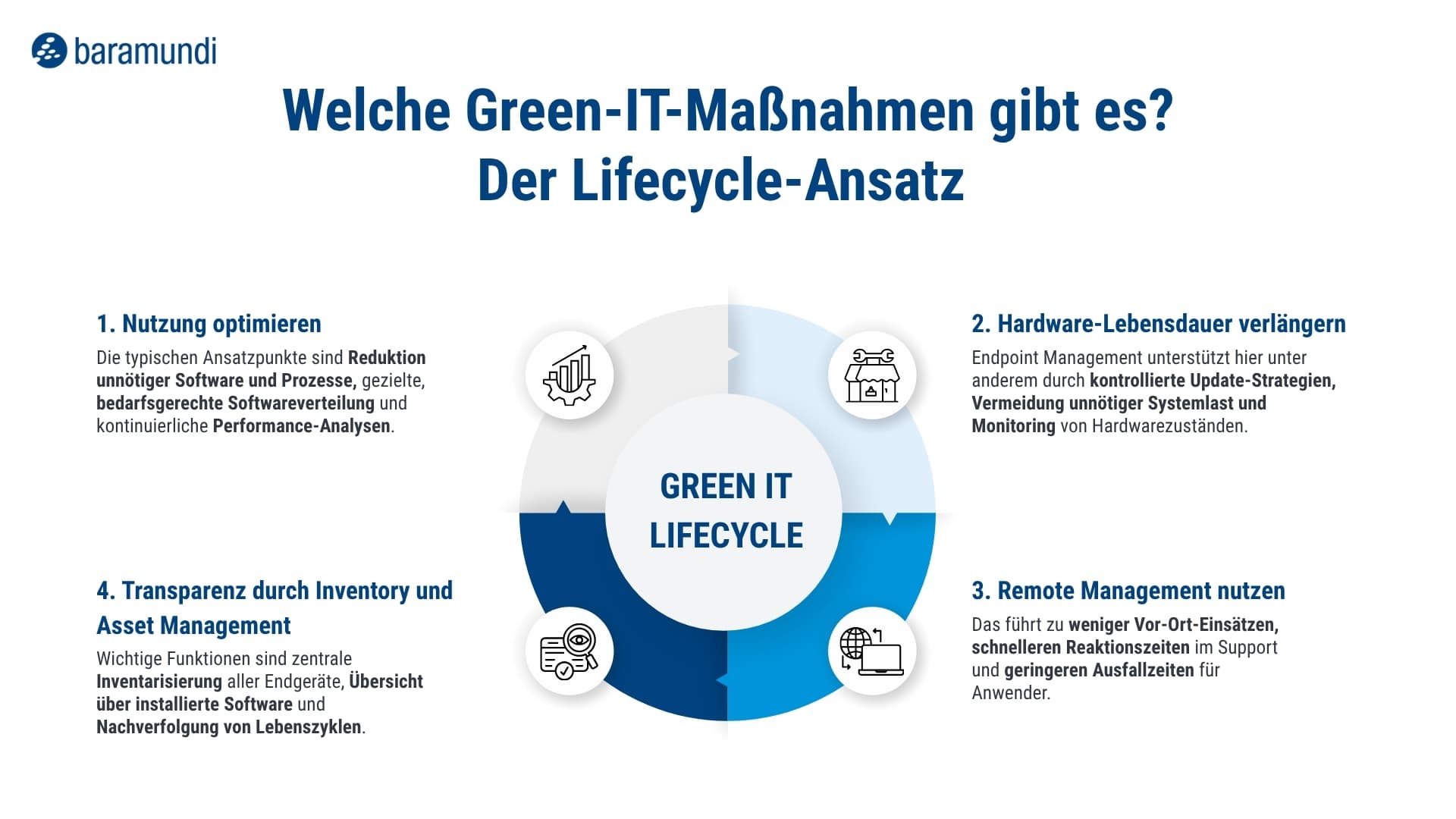
Effective Green IT measures span the entire device lifecycle, from commissioning to decommissioning. Individual measures only achieve their full effect when these four phases work together.
1. Optimize Usage
A system’s actual efficiency is determined during ongoing operation. Unnecessary loads often arise from uncontrolled software installations, background processes, or poorly coordinated updates.
Typical areas for improvement:
- Reducing unnecessary software and processes
- Targeted, needs-based software distribution
- Continuous performance analyses
The technical background: Systems under high, sustained load consume more energy and are more susceptible to disruptions. At the same time, perceived performance for users (opens in new tab) declines, leading to productivity losses. (opens in new tab)
2. Extend hardware lifespan
The service life of end devices is a key lever for resource efficiency in the context of Green IT. Every premature replacement not only incurs costs but also results in additional material and energy consumption throughout the supply chain.
Endpoint management supports this through, among other things:
- controlled update strategies
- Avoiding unnecessary system load
- monitoring hardware status
Why this matters: Stable systems remain operational longer. This reduces not only capital expenditures (CAPEX) but also operational costs associated with rollouts and migrations (opens in new tab).
3. Use Remote Management
Many traditional IT processes require physical intervention, such as for maintenance, fault analysis, or software installations. Remote management features make it possible to perform these tasks centrally.
This results in:
- fewer on-site visits
- faster response times for support
- less downtime for users
The benefits extend beyond environmental considerations: In addition to reducing travel, support costs are lowered, and problems are resolved more quickly, which directly improves employee productivity (opens in new tab).
4. Transparency Through Inventory and Asset Management
A long-term IT strategy requires that companies have a thorough understanding of their own infrastructure. In many cases, however, there is no complete overview of existing devices, their usage, or their condition.
Key features include:
- Centralized inventory of all end devices (opens in new tab)
- Overview of installed software
- Life cycle tracking
Without this transparency, several risks arise: unused devices incur costs, outdated systems increase the attack surface, and it becomes more difficult to make informed decisions about continuing to use or replacing them.
Reuse Instead of Replacement: Linux as a Green IT Option
One concrete approach to extending the useful life of hardware as part of Green IT is the use of alternative operating systems. Linux, in particular, can help ensure that older devices continue to function effectively. (opens in new tab)
What does this mean in practice? Devices that no longer support current versions of Windows with adequate performance can continue to be used with lightweight Linux distributions for specific purposes (opens in new tab).
Typical scenarios include:
- Use as thin clients
- Use in kiosk or display systems
- Use for specialized applications
It’s important to note that Linux isn’t automatically more secure; rather, it requires (like any operating system) consistent patch and configuration management.
The main advantage lies in resource utilization: existing hardware is used for longer, electronic waste is reduced, and the need for new investments is delayed. At the same time, such environments can be centrally managed via endpoint management and integrated into existing green IT processes.
7 Good Reasons to Switch to Linux
Windows 10 support is expiring for businesses without expensive ESU contracts. Windows 11 requires new hardware, and many IT managers are wondering if there isn’t another way.
Our Best Practice Guide, “7 Good Reasons to Switch to Linux,” shows how you can use Linux to reduce licensing costs, continue using existing hardware, and at the same time strengthen security and digital sovereignty.
The Role of Endpoint Management in Green IT
Many Green IT measures can only be implemented efficiently if they are standardized and automated. This is exactly where endpoint management comes into play: It provides the necessary control over a growing and heterogeneous device fleet.
Typical features include:
- centralized control of power and device settings
- automated software deployment
- structured patch management
- comprehensive inventory
The key advantage lies in scalability: Green IT measures do not have to be implemented manually but can be rolled out consistently across all systems.
A unified endpoint management solution such as the baramundi Management Suite (opens in new tab) can help centrally orchestrate these processes and make their impact transparent through key performance indicators.
Why Green IT Is a Business Issue
In addition to environmental goals, economic and regulatory factors are the primary focus in practice.
These include:
- Cost control: Lower energy consumption and extended hardware lifespan reduce operating and one-time costs
- Compliance and reporting: Requirements under the CSRD or internal guidelines call for reliable data
- Operational stability: Efficiently configured systems are less prone to failures and easier to operate
Green IT thus has a direct impact on key business metrics (operating costs, investment planning, risk assessment, and more). Companies that manage their IT in a structured and data-driven manner benefit in two ways: through lower costs and greater transparency toward internal and external stakeholders.
Conclusion: Green IT as a Strategic Lever for Future-Ready IT
Green IT has long been more than just a sustainability label. When implemented correctly, it combines environmental responsibility with tangible economic benefits. Organizations that consistently implement Green IT measures throughout the entire device lifecycle and rely on structured endpoint management lay the foundation for lower costs, greater operational stability, and robust proof of compliance.
Categories: Management Suite, Endpoint Management