
Cyber Insurance for Businesses: What It Covers, and What It Does Not

Cyber insurance is now a relevant component of corporate IT risk management. It does not replace security measures, but it can mitigate the financial consequences of cyberattacks, data protection incidents, and IT outages. Companies with digital processes, sensitive data, or high availability requirements in particular should therefore take a close look at the scope, requirements, and limitations of such cyber insurance.
Cyber Insurance – At a Glance
- Cyber insurance mitigates the financial consequences of cyberattacks, data loss, and business interruptions.
- Typical coverage components include forensics, recovery costs, legal advice, and crisis communication.
- Cyber insurance costs depend heavily on the company’s security level, but structured IT risk management in particular has a direct impact on premium levels.
- Before entering into a contract, insurers review patch status, backup processes, MFA, and access controls.
- Cyber insurance is particularly worthwhile for companies with a high level of digital dependency.
What Is Cyber Insurance?
Cyber insurance protects companies against the financial consequences of cyberattacks, data loss, business interruptions, and certain liability or crisis-related costs.
Depending on the policy, this may include IT forensics, recovery costs, legal advice, notification obligations, or crisis communication.
Some providers also refer to their product as Cyber Risk Insurance or cyber risk coverage. In general, this refers to the same scope of coverage.
What Does Cyber Insurance Cover?
Typical components of cyber insurance include data recovery, business interruption, Incident Response, legal costs, and the costs of external specialists. In practice, cyber insurance is often a combination of liability, first-party loss, and assistance services.
Why Your Business Needs Cyber Insurance
For security managers, there are two types of companies: those that have already been attacked and those that will be. The economic damage caused by such cyberattacks is
high because attacks today often affect not only data, but can also bring entire business processes to a standstill.
A successful attack can lead to production downtime, support effort, recovery costs, contractual penalties, reporting obligations, and reputational damage. Beyond IT, this
represents a risk to revenue, delivery capability, and compliance for decision-makers, making it a central issue in risk management.
What Costs Arise in the Event of a Loss
The financial consequences of an incident usually consist of several components:
- Forensics and Incident Response
- Recovery of systems and data
- Business interruption and productivity loss
- External legal advice and reporting obligations
- Communication with customers, partners, and supervisory authorities
Indirect costs in particular are often underestimated: Just a few hours of downtime can result in follow-up organizational costs that significantly exceed the actual technical recovery costs.
What a Good Policy Requires
Before entering into a contract, cyber insurers usually assess the company’s security posture very closely. Insurers want to know how Endpoints are managed, whether
patches are deployed promptly, whether backups are tested, and whether access is sufficiently secured.
Typical requirements include:
- Current patch status
- Functioning antivirus protection or EDR
- MFA for critical access points
- Documented backup and restore processes
- Centralized inventory management and traceability
- Defined responsibilities for Incident Response
What is important: Anyone who provides embellished information in the questionnaire or subsequently fails to comply with agreed security measures risks problems with claims settlement in the event of a loss. In practice, it is therefore not only the policy that matters, but also the ability to reliably demonstrate the company’s own security posture; an aspect that is also becoming increasingly relevant from a regulatory perspective, for example in the context of NIS2 or DORA, while at the same time strengthening the company’s digital sovereignty.
Minimize Cyber Risks—with Systematic Vulnerability Management
Cyber insurance is only as good as the underlying IT security concept. In our white paper, you will learn how to identify risks early and minimize them in a targeted manner through
structured vulnerability management.
Download the free white paper now
How a UEM Solution Creates the Requirements for Cyber Insurance
This is where Unified Endpoint Management with a solution such as the baramundi Management
Suite plays an important role. It helps companies centrally implement and demonstrate security and compliance requirements, thereby meeting precisely the requirements
that insurers expect for cyber insurance.
Particularly relevant are:
- Hardware and software inventory management
- Patch Management for timely security updates
- Vulnerability Scanning for identifying critical vulnerabilities
- Software distribution for standardized security and agent rollouts
- Backup and restore support for recovery in an emergency
For IT administrators, this means fewer individual manual steps, clearer processes, and better evidence for management, auditors, and insurers. For company management, it means a lower risk of downtime, improved predictability, and a greater chance of reasonably calculated insurance terms as part of company-wide IT risk management.
When Cyber Insurance Makes Sense
Cyber insurance is especially useful for companies that work with sensitive data or depend on digital availability. This includes freelancers, service providers,
manufacturing companies, healthcare organizations, retailers, and organizations with a high dependency on IT-supported processes.
Cyber insurance is less useful if the company has few digital dependencies or if fundamental security measures and existing contracts already cover a large portion of the
relevant risks. Before taking out a policy, companies should therefore always assess which losses are already covered by other policies or organizational controls.
What Does Cyber Insurance Cost?
The cost of cyber insurance depends primarily on company size, industry, revenue, security level, coverage amount, and deductible. The number of insured types of loss and
the quality of internal security processes also directly affect the price.
A low-cost policy is not automatically the best choice. What matters is whether the policy matches the company’s actual risks and whether it genuinely covers the relevant
costs in an emergency. Companies with robust IT risk management and demonstrably strong cyber hygiene often receive more favorable terms.
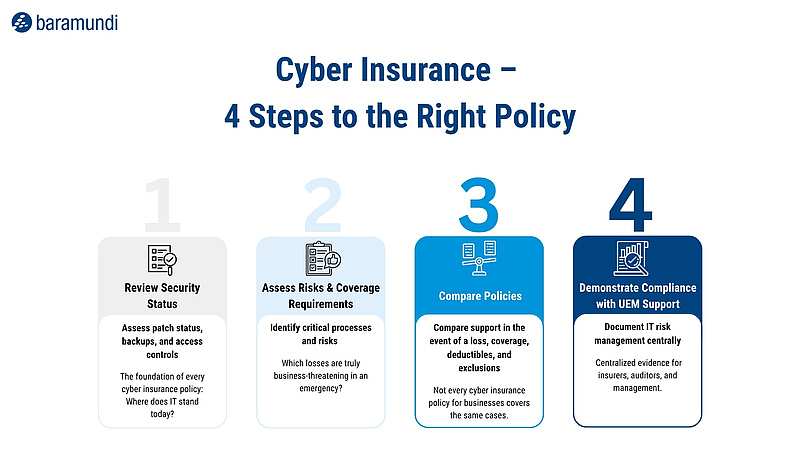
What Companies Should Consider Before Taking Out a Policy
Before taking out a policy, companies should systematically assess their own security and insurance status:
- Review existing insurance policies for cyber coverage components
- Assess critical business processes and data assets
- Compare the insurer’s technical minimum requirements with the company’s own IT environment
- Document backup, patch, and incident processes
- Compare coverage amounts, deductibles, and exclusions
Exclusions are particularly important: Not every policy fully covers serious organizational deficiencies, inadequate security measures, or certain incidents such as contractual penalties, supply chain disruptions, or reputational damage. Companies that fail to review this carefully before taking out a policy may ultimately purchase nothing more than a false sense of security.
Conclusion: Cyber Insurance Does Not Replace Security
Cyber insurance is not a cure-all, but it is a useful component of IT risk management. It helps companies resume operations quickly and limit financial damage when an
incident occurs despite good preparation.
However, one thing remains decisive: The better a company manages its Endpoints, patches, backups, and security processes, the lower the risk; and the more robust the basis
for insurability and compliance. This is exactly where UEM processes come into play: They make risks visible, reduce manual effort, and create the transparency companies
need for cyber insurance for businesses in an emergency.