
Patch Management: Processes, Software and Best Practices for IT Teams

Patch management protects organizations from cyberattackers who exploit known but unpatched vulnerabilities in operating systems, applications, and security software, which are among the most common entry points for successful attacks. Patch management best practices help minimize risk and maintain compliance by ensuring that patch and update distribution is controlled, prioritized, and traceable.
Patch Management – At a glance
- Patch management is the continuous process of prioritizing and installing software updates in a timely manner.
- It closes security gaps, improves system stability, and reduces the risk of cyberattacks and compliance violations.
- Modern patch management software automates vulnerability detection and prioritizes patch deployment, reducing mean time to remediate (MTTR) and freeing IT teams to focus on strategic work.
- Patch management best practices such as risk prioritization, pilot groups, and defined maintenance windows make the process secure and efficient.
What is a software patch?
A software patch is a targeted update that fixes bugs or closes known vulnerabilities listed in the Common Vulnerabilities and Exposures (CVE) database maintained by government and industry organizations. Patches differ from regular updates and new software versions, which often include more extensive changes and new features.
What is patch management?
Patch management encompasses measures to keep software up to date by promptly distributing and confirming the installation of security-related and other patches from a central IT management console. This is essential in enterprise environments, where outdated software increases the risk of IT security incidents, compromises data integrity, and undermines compliance.
What is meant by “patched”?
A system is considered patched when a known vulnerability or bug has been resolved by applying the corresponding patch to affected systems and documenting the
updated status.
An example: An IT admin discovers that a CVE related to a faulty file-parsing function in PDF software affects multiple systems at their company. A patch is
available from the vendor. However, if the admin fails to distribute the patch and confirm that it was successfully installed on all affected endpoints, the company is only one
phishing email away from a costly cyberattack. Without a well-designed patch management process, the risk of an attack increases.
Why is patch management necessary?
Unpatched systems remain widespread. The Kaspersky Security
Bulletin reports that an average of 500,000 new malicious files were discovered daily in 2025, many of which exploited unpatched vulnerabilities.
The Verizon 2026 Data Breach
Investigations Report found that exploitation of known vulnerabilities doubled in 2025 and accounted for 32% of 22,000 confirmed data breaches in 145 countries, highlighting “how
unpatched or otherwise exposed systems are still rolling out the red carpet to cybercriminals.”
Such incidents lead to data loss, outages, high remediation costs, or even fines. Given this threat landscape, consistent patch management is the only safe approach.
The advantages of patch management at a glance:
- Reduction of the attack surface through timely patching
- More stable, better-performing systems via bug fixes
- Compliance with regulatory requirements (e.g., ISO 27001, NIS2, HIPAA, GLBA, etc.)
- Better control through centralized distribution and confirmation of software patch installations on all affected endpoints
- Reduced manual effort by automating vulnerability detection, patch distribution, and status updates, freeing time for strategic IT work
Risk-based prioritization: Not every patch is equally urgent
Patches are important, but some are more important than others. For example, patches for CVEs that are more readily exploited or affect a large number of systems (e.g., a
Common Vulnerability Scoring System (CVSS) severity score > 8) take absolute priority. The same applies to internet-facing systems or systems with administrative rights.
Less critical bug fixes or feature updates can follow in stages. This risk-based approach enables IT teams to focus on more serious or imminent threats while deferring
routine or convenience updates.
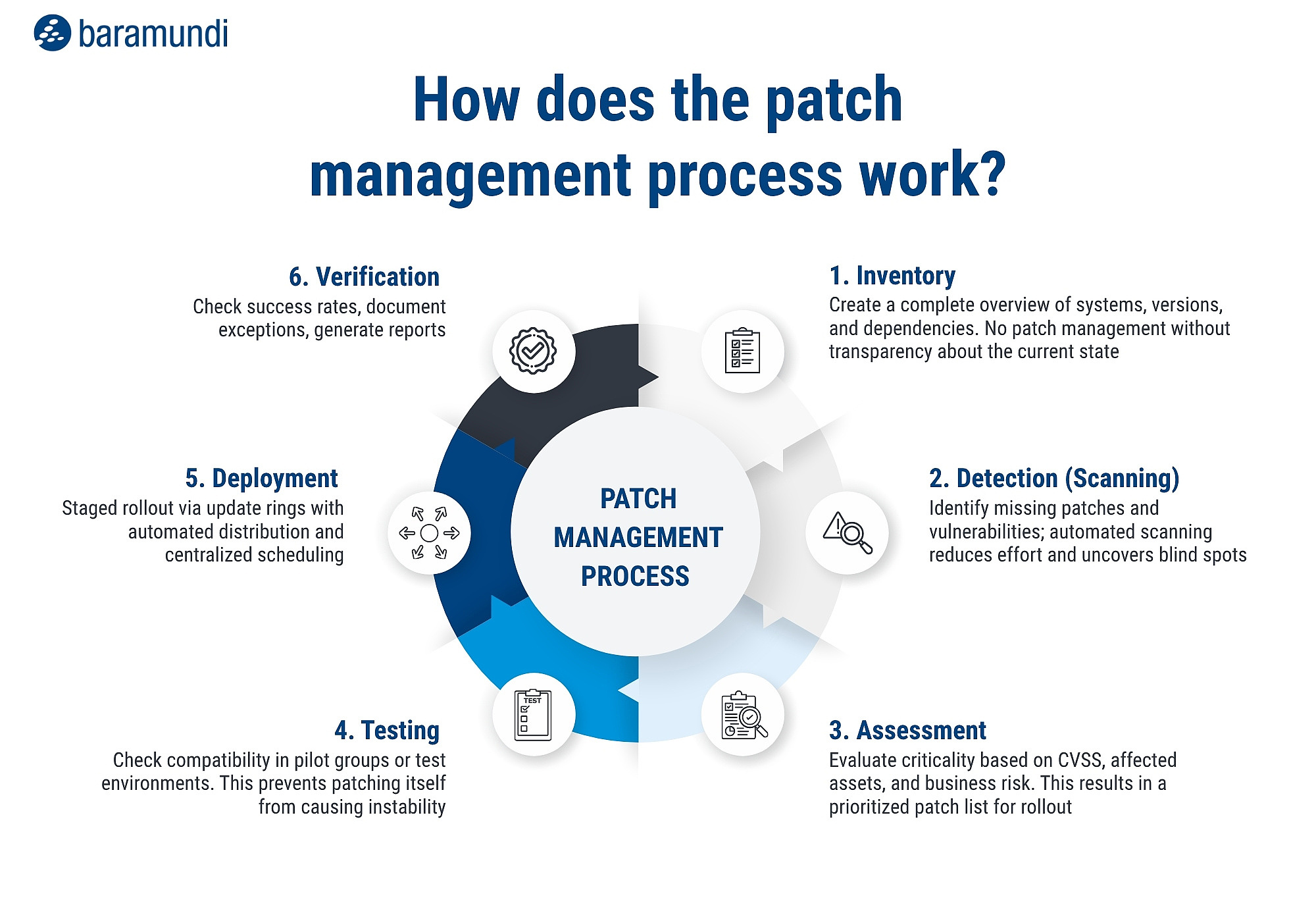
How does the patch management process work?
A modern patch management process consists of six core steps, ideally automated:
Patch management software: What modern tools deliver
What does patch management software do? It automates the entire patch management process, from detecting missing patches to distributing and verifying installations. This reduces manual
effort, minimizes errors, and documents completion.
Modern patch management software offers:
- Automated patch distribution for Microsoft and third-party applications
- Cross-platform support (Windows, macOS, Linux, mobile devices)
- Rollout planning with phased ring deployments and maintenance windows
- Central dashboards, audit trails, and compliance reports
IT teams that invest in specialized patch management software significantly reduce patching effort and MTTR while simplifying required compliance reporting.
Patch management and compliance
In addition to improving IT team efficiency, patch management strengthens compliance efforts.
- Patch management is mandatory under EU regulations and required by cyber insurance underwriters in the US. Risk-based vulnerability management and remediation must be documented and verifiable.
- ISO 27001 considers patch management one of the core controls for information security.
For IT management and executive leadership: implementing best practices for patch management not only reduces cyber risks but also improves audit reporting and stakeholder trust.
Patch management is mandatory: NIS2 makes it binding in the EU
Organizations that fail to properly manage and remediate vulnerabilities risk more than a cyberattack. Our NIS2 white paper explains what the regulations require of IT managers across areas such as risk management and incident response.
Putting patch management best practices into action
Patch management best practices enable IT teams to implement efficient, structured, and secure processes for detecting and remediating IT vulnerabilities, regardless of company size or industry:
- Automate scanning: To detect security vulnerabilities quickly
- Prioritize patches: Apply critical updates first and roll out less important patches in phases
- Use pilot groups: Test patches in pilot groups before company-wide rollout
- Define maintenance windows: Deploy updates outside of regular business hours whenever possible
- Communicate clearly: Inform users early about planned deployments and collect feedback
- Clarify responsibilities: Define ownership for each process step
Conclusion: Patch management as the foundation of IT security
Patch management is an indispensable component of any IT security strategy. Only organizations that consistently and promptly patch and update systems can close security
gaps, avoid operational disruptions, meet regulatory requirements, and reduce IT workloads.
By following best practices and implementing a well-designed process with modern IT endpoint management software, effective, efficient and secure patch management is
practical even in complex, hybrid IT environments. The benefits are measurable: fewer incidents, lower costs, less downtime, and clear ROI through automation and compliance. Organizations
that implement patch management best practices also build a stable foundation for future-proof IT infrastructure.