
Data Hygiene: Processes & Best Practices for IT Administrators

Data is only valuable if it is accurate, up-to-date, and consistent — and if there isn’t more data than is actually needed. This is precisely where data hygiene comes in. It encompasses all measures used to keep data clean, reduce errors, and remove duplicates, outdated entries, and inconsistent formats.
Data Hygiene – At a Glance
- Data hygiene ensures that IT systems, such as AD, Entra ID, Intune, and cloud assets have accurate and up-to-date data.
- Poor data quality increases help desk workload, undermines automation, and complicates compliance efforts.
- Data cleansing is not a one-time project but an ongoing operational process that includes standards, audits, and monitoring.
- Many existing tools can be used to implement individual steps in the data hygiene process.
- Best practices for data hygiene include naming conventions, source-level validation, deduplication, and clearly defined responsibilities.
Let’s imagine this scenario: Ever since a medium-sized company with 1,200 employees merged two locations, the IT team has been struggling with 15% of Active Directory accounts being
duplicated. Outdated email addresses are blocking SSO logins. About one-tenth of the workforce reports this issue each month, and each request takes 20 minutes to resolve. These
data hygiene shortcomings cost the equivalent of about one-quarter of a full-time employee.
This hypothetical example shows that data hygiene is not an end in itself but a vital set of practices that prevent unnecessary support costs, automation errors, and
security risks in complex IT environments.
What is data hygiene?
Data hygiene refers to the set of processes used to keep data accurate, up to date, and usable.These processes include verifying, standardizing, cleaning, deduplicating, updating, and regularly monitoring data records. It’s important to note that data hygiene is not a one-time corrective measure.Data is constantly changing, systems are growing, and formats vary. Errors can occur at many stages of data collection. Therefore, it is an ongoing process and a key driver of data quality and system stability.
Why is data hygiene important?
Inaccurate data arises primarily when IT systems grow, are migrated, or merged. Poor-quality data leads to higher costs and more operational problems. In particular,
incomplete, duplicate, or outdated data records slow processes and require manual follow-up.
For IT admins, the consequences are often indirect yet clearly evident in day-to-day operations:
- Support tickets increase due to inconsistent master data
- Automation efforts fail when fields are not standardized or incomplete
- Migrations and integrations become more expensive because legacy issues must first be resolved
- Compliance processes become more time-consuming when data is not properly maintained. In the EU, NIS2 mandates a comprehensive asset inventory and imposes fines of up to €10 million or 2% of revenue for non-compliance. DORA requires financial institutions to fully identify and document all ICT assets, including cloud services and dependencies on third-party providers.
- In addition to data quality, attention is turning to the locations and legal frameworks governing data storage.
This means that data hygiene is not just about maintaining clean data sets but also a direct factor in efficiency. The more consistent and up-to-date the data is, the smoother workflows run.
What is the difference between data hygiene, data quality, data governance, and data sovereignty?
Many terms coexist in data management. The differences matter because each level requires different tools and responsibilities:
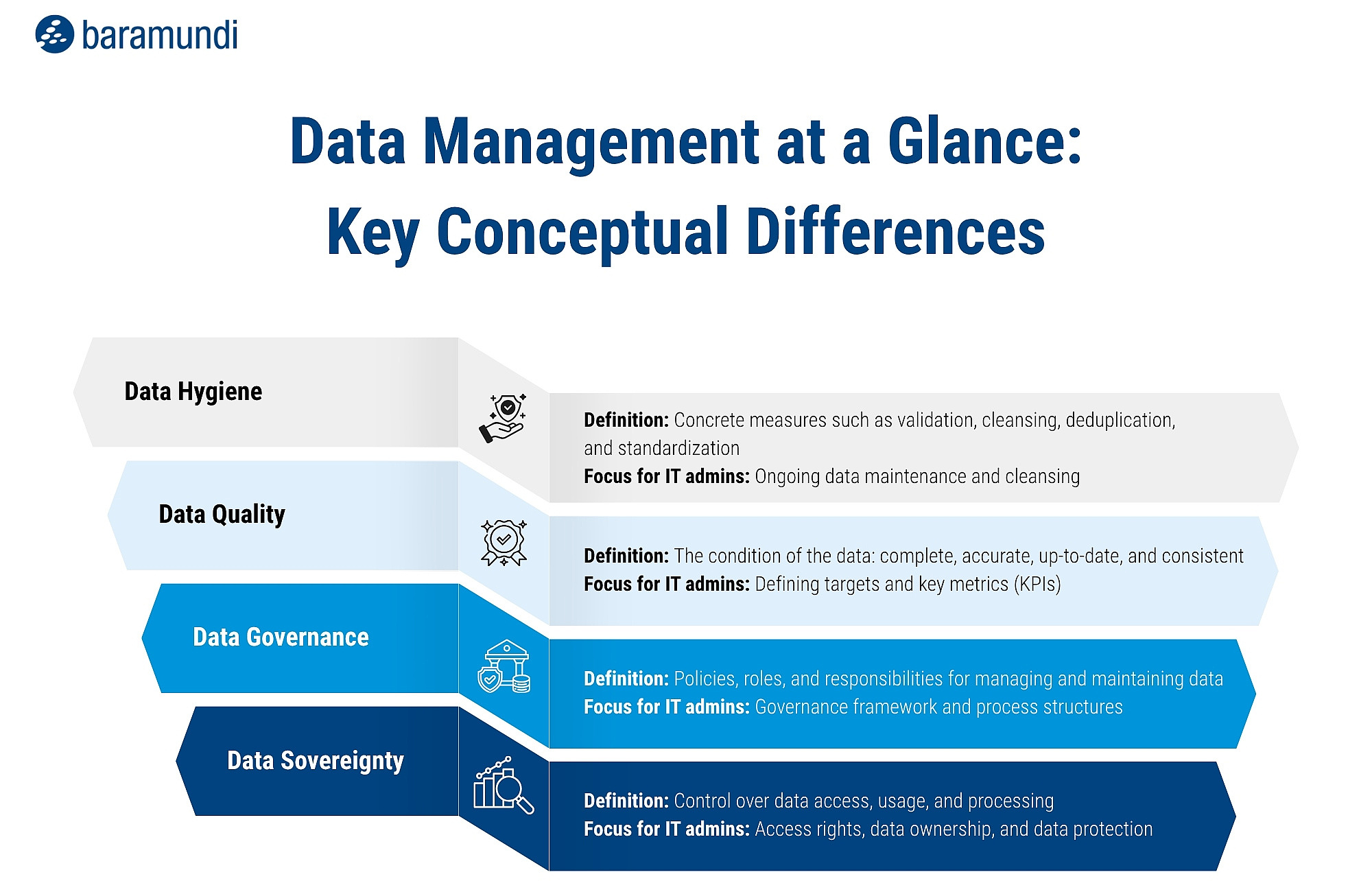
In short: Data hygiene is the active process, and data quality is the goal. Data governance establishes the regulatory framework, while data sovereignty ensures control over data.
Data hygiene approaches and automation
There is no single software solution that covers the entire data hygiene process. What matters are specific functions that should be implemented in existing tools:
- Validation: Automated checks for consistency, completeness, and format compliance
- Deduplication: Detection and merging of redundant data records such as user accounts or asset entries
- Script-based solutions (PowerShell, Python) and monitoring tools provide additional support as needed. UEM solutions maintain a centralized, consistent inventory of endpoints and asset data, forming a crucial foundation for the entire data hygiene process.
- Automation and rule-based scripts in UEM software and other tools can handle recurring data hygiene tasks such as flagging inactive accounts, reporting format errors, and identifying orphaned records.
- AI is also seeing increased use because it can scan large datasets for patterns and inconsistencies more quickly than manual methods.
Best Practices Guide: Digital Sovereignty and Data Management
Data hygiene is a key building block on the path to digital sovereignty. Our Best Practices Guide explains how companies can reduce critical dependencies on software vendors, meet EU
compliance requirements, and build resilient IT infrastructure.
Download the Best Practices Guide now
Best practices for data hygiene
A one-time cleanup isn’t enough. Instead, data hygiene processes must be embedded in day-to-day operations and quarterly reviews using self-imposed metrics. Simply cleaning
up individual data records isn’t an effective or durable solution. Only standards, automation, and regular monitoring yield lasting results.
The following 7 IT practices have proven effective and can be implemented immediately:
1. Establish data standards
Define naming conventions for hostnames (“srv-dc1-prod”), user IDs, and locations.
2. Build validation into the source
Implement required fields (IP and email addresses), formatting rules, and plausibility checks directly within forms and APIs.
3. Clean up duplicates
Regularly check for and merge duplicate AD accounts and assets in inventory systems using matching logic instead of manual searches.
4. Audit data on a recurring basis
Identify inactive and orphaned data records, such as inactive user accounts or decommissioned devices.
5. Verify data accuracy
Correct outdated email addresses or hostnames. Controlled updates preserve important references and links.
6. Clearly assign responsibilities
Designate a person responsible for each system who conducts quarterly reviews. Without clear ownership, standards remain mere theory.
7. Set up monitoring with KPIs
Visualize defined metrics on a dashboard (e.g., duplicate rate, decay rate)
Data hygiene is worthwhile only if it’s sustained
Data hygiene is an ongoing operational process, not a one-time cleanup.Those who implement it systematically, with clear standards, automated checks, and regular audits, will reduce errors, lower operational costs,and lay a foundation for stable automation and compliance.The tools used matter less than a consistently implemented process. That process determines the data quality on which every subsequent IT initiative depends.