![[Translate to english:]](/fileadmin/_processed_/3/3/csm_Header_Access_Point_26d21f5292.jpeg "[Translate to english:]")
APN: Secure Mobile Communication with a Private Access Point Name

Organizations with large numbers of mobile employees face a common challenge: securing users’ data connections worldwide, even when Wi-Fi is unavailable. The answer is a private Access Point Name (APN). But what exactly is an APN, what advantages does it offer, and how can it be set up and managed?
APN – at a glance
- An Access Point Name (APN) connects mobile devices to the cellular data network.
- Organizations can configure an APN to securely connect authorized devices to corporate networks.
- A private APN offers greater security and flexibility when integrated into an enterprise network architecture.
- APNs are especially valuable for M2M (machine-to-machine) connections and for securing communications within globally distributed teams.
What is an APN?
An APN (Access Point Name) is a gateway that connects a device to a mobile carrier's data network. It is managed by the carrier as the primary link between a device’s SIM
card and the cellular network. On modern SIM cards, an APN configuration is usually provisioned automatically.
One important detail: technically, an APN is defined by an APN profile that includes the APN name, required protocols, authentication credentials, and often
MCC/MNC values (Mobile Country Code / Mobile Network Code). These parameters are essential for establishing a secure mobile data connection.
Overview: When a private APN makes sense, and when it doesn't
A private APN is especially beneficial for organizations that:
- Operate a large fleet of mobile endpoints
- Have enhanced security, compliance, or location requirements for international teams, field service operations, M2M/IoT connectivity, and other scenarios
However, a private APN only delivers its full potential when it is:
- Part of a centrally managed segmentation strategy, e.g., via Mobile Device Management (MDM)
- Integrated into a Zero Trust architecture that includes MDM/UEM, VPN (Virtual Private Network), firewall, endpoint security policies, and monitoring
- Properly combined with complementary solutions such as public APNs with per-app VPN, full-tunnel VPN, or Zero Trust gateways
APN vs. VPN – what's the difference?
A private APN defines how and via which path a device connects to the mobile network (carrier-side segmentation and device grouping). A VPN, by contrast, ensures that data traffic is encrypted and routed to the corporate network in accordance with defined policies.
What makes up an APN? And what are MCC and MNC?
- MCC and MNC: The Mobile Country Code (MCC) and Mobile Network Code (MNC) together identify the mobile carrier
- APN type: Defines the connection purpose, e.g., "default" for general data traffic, "mms" for multimedia messaging, or "fota" for over-the-air firmware updates
- Username/password: Recommended for authentication when using private APNs
MCC and MNC values are embedded in the IMSI (International Mobile Subscriber Identity) and uniquely identify the subscriber on the network. These values are typically entered centrally via an MDM solution during APN profile deployments.
Which APN types are available?
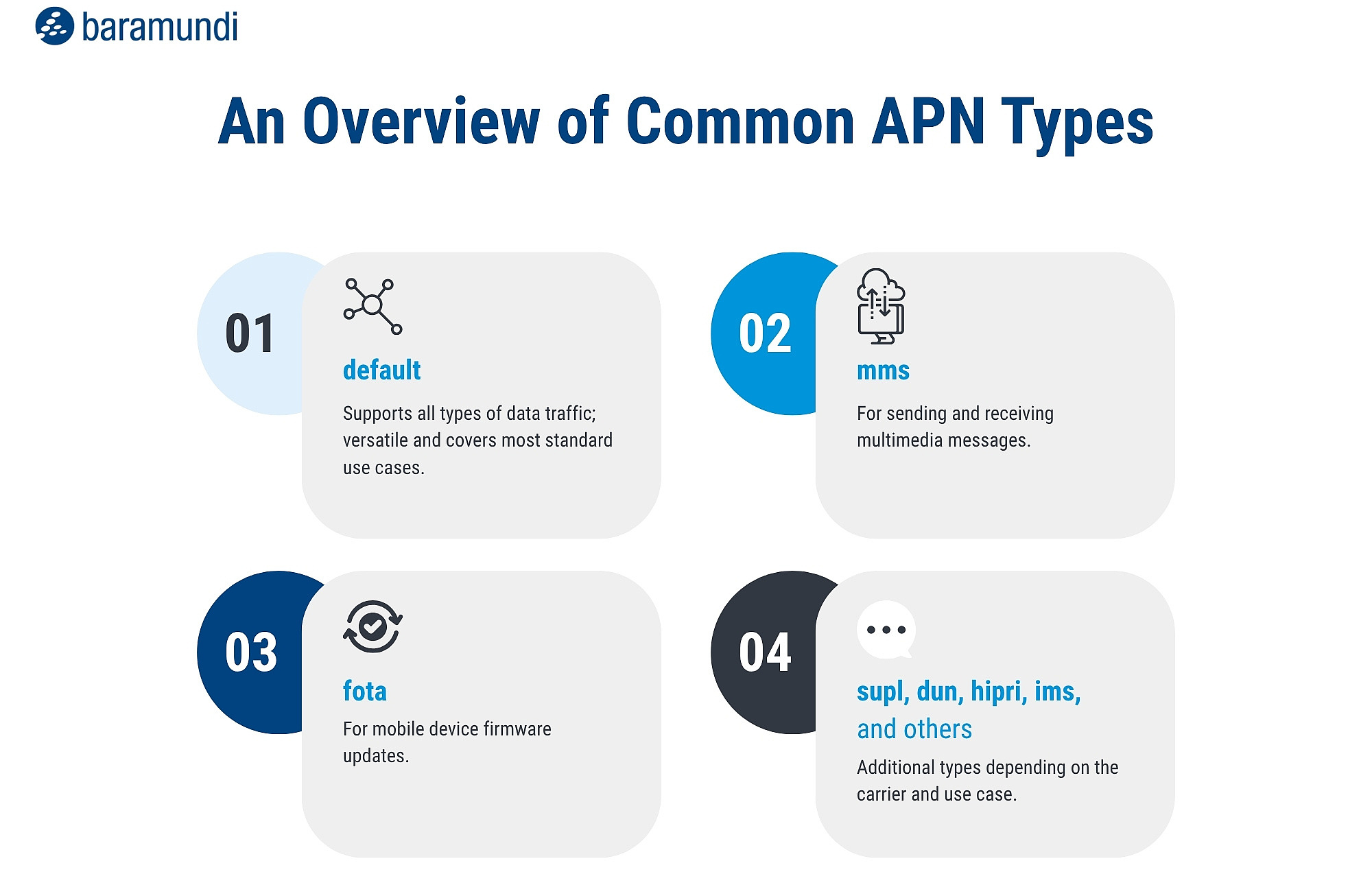
The APN type determines the type of connection it supports. Common types include:
- default: Supports all types of data traffic; versatile and covers most standard use cases
- mms: for sending and receiving multimedia messages
- fota: for mobile device firmware updates
- supl, dun, hipri, ims, and others: Additional types depending on the carrier and use case
Centralized APN management
Unified Endpoint Management (UEM) platforms, such as baramundi Management Suite, combine traditional endpoint management with Mobile Device Management (MDM) capabilities. UEM solutions support cross-platform deployment and management of APN profiles for Android and iOS and integrate APN management into a broader MDM and security ecosystem.
All mobile devices under control?
A private APN secures mobile connections but managing mobile endpoints is more involved. From enrollment and BYOD to update management, our whitepaper "Secure Mobile Device Management with
Enterprise Mobility Management" has the answers.
Download the whitepaper now
Setting up a private APN: requirements, architecture, and implementation
Deploying a private APN requires more than a suitable carrier contract. A clear IP and network design, MDM/UEM infrastructure, and well-defined roaming policies are equally
essential.
A standardized rollout process, continuous monitoring of active APN connections, logging, and testing in international environments are also important to avoid unpleasant
surprises, such as data loss, unexpected roaming charges, or security gaps.
Set Up an APN in 4 Steps
Setting up a private APN typically involves four steps:
- Provisioning: Not all carriers support private APNs equally. Clarify this with the carrier early in the process.
- Configuration: Incorrect profile settings, such as APN name, type, authentication, or network parameters, will completely block data connectivity.
- Deployment: Private APN profiles should be deployed only to fully managed devices; BYOD devices require a separate strategy.
- Validation: Without monitoring and regular checks, there is no reliable way to confirm that devices are connecting via the private APN.
Why APNs matter beyond IT
APNs are typically the responsibility of IT teams, but they are also relevant to company leadership and other departments because of their implications for security, cost control, and compliance.
- Executive leadership: A private APN reduces the risk of data leakage and protects business-critical information. It also enables standardized global mobile access, which is essential for international growth and scalable business models.
- Finance/Controlling: Centralized APN management enables consolidated tracking and optimization of data usage and tariffs, simplifying forecasting and internal cost allocation.
- Security/Compliance: APN-based segmentation creates clearly defined security zones for different device groups and provides integrated logging, policy enforcement, and access control, making it easier to demonstrate compliance with data protection requirements.
Conclusion: Use APNs deliberately and strategically
A private APN does not replace a VPN or a Zero Trust security framework, but it is a powerful building block for securing and managing mobile connectivity. When combined with UEM, monitoring, and a well-designed network architecture, it provides a stable infrastructure for globally mobile teams without complicating day-to-day IT operations.