
Interoperability in IT: From Data Silos to Connected Systems

There’s a wealth of data from endpoint management, ITSM, asset/configuration data, enterprise resource planning systems, and other systems that can be used to manage and optimize IT infrastructure. But that data is often siloed across systems and rarely reaches the tools IT teams use every day. This creates more manual work and avoidable inefficiencies.
Interoperability in IT: At a Glance
- A lack of interoperability among device data, service and ticketing data, asset and configuration data, and business planning data wastes time, increases error rates, and slows decision-making.
- Open interfaces aren’t just a technical nicety. They’re a strategic requirement for a scalable IT infrastructure.
- When systems don’t communicate with each other, it leads to manual processes, outdated data, and avoidable gaps in compliance and security.
- baramundi Proactive Connect provides telemetry data and DEX metrics from baramundi Proactive Hub via APIs, serving as the foundation for an interoperable and scalable IT infrastructure.
The real problem is interoperability
In most companies, ticketing systems, monitoring platforms, ITSM tools, SIEM solutions, and UEM systems (Unified Endpoint Management) are separate products from different vendors. While each works as a standalone solution, together they usually don’t function as IT teams need them to.
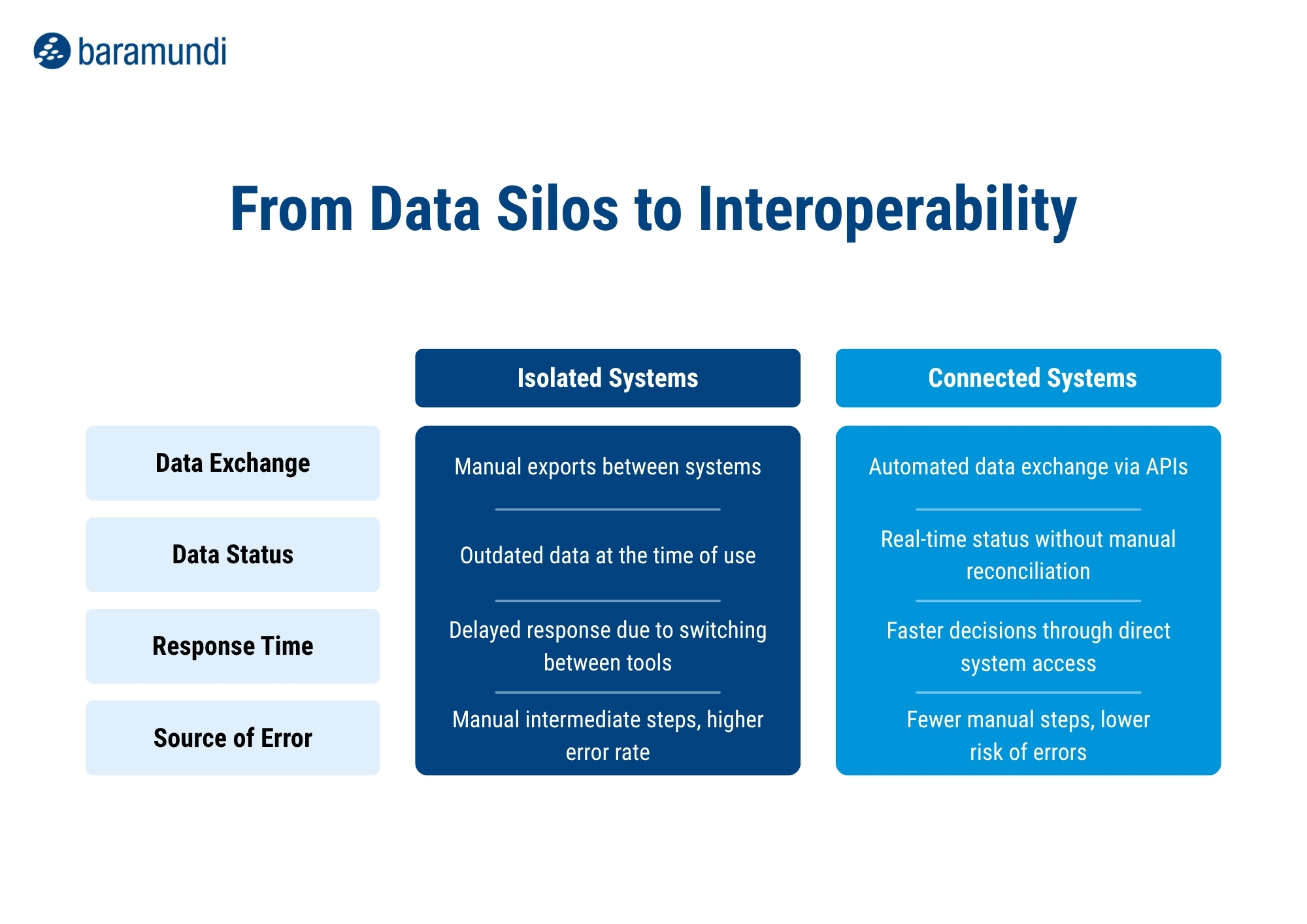
Data from each system is often exported, copied, and pasted, resulting in information that is outdated or inaccurate before it can be used for its intended purpose. The actual work of solving problems and managing processes falls by the wayside because IT teams end up serving as manual liaisons between systems.
The solution to this is interoperability. Those who have it work more efficiently, while those who don’t pay the price in the form of extra effort, more errors, and slower response times
Interoperability Explained Simply
Interoperability enables different IT systems to exchange data and share functions without manual intervention. In enterprise IT, this applies to interactions between UEM, ITSM, CMDB, and ERP systems.
Technically, interoperability is usually achieved through open interfaces that connect systems without introducing dependencies. Without this IT system integration, siloed data sets remain isolated and can be merged only through additional manual effort
Why interoperability is strategically important
Interoperability has long been a concern for system architects and teams managing integration projects. Today, it is a strategic priority for the entire IT organization. Modern enterprise IT comprises dozens of systems: UEM solutions manage endpoints, ITSM platforms handle support, CMDB systems document the infrastructure, ERP systems map business processes, and monitoring, security, and analytics tools run alongside them. While each system was built for a specific purpose, they weren’t designed to operate in isolation.
Interoperability becomes strategic as IT infrastructure grows. New tools are being added, processes are becoming more complex, and compliance requirements are increasing. Anyone relying on manual data transfers in this environment cannot scale. Manual processes create a squared increase in extra work and reinforce data silos.
APIs (Application Programming Interfaces) provide open, standardized connections between systems and fundamentally change how they interact. They enable systems to exchange data seamlessly without altering or limiting their core functionality. Individual components can be replaced or added without jeopardizing the entire system. They also lay the foundation for automation that extends beyond system boundaries.
Where a lack of interoperability causes problems
Symptoms of a lack of integration appear in four scenarios familiar to IT teams:
- Support without context: A ticket comes in. The ITSM tool shows what the user reported, not what’s actually happening on the affected endpoint. That information is in the DEX system, which isn’t connected to the ITSM system. The support staffer switches tools, searches for the endpoint, and manually reconciles the data. That may take only a few minutes, but it adds up over time.
- Outdated CMDB data: A CMDB solution is only as good as its data. If device status, software versions, or configuration changes aren’t automatically synchronized with the UEM system, a growing gap opens between the documented and actual states. Decisions based on outdated CMDB entries and siloed data are costly.
- Manual compliance reporting: Monthly reports on update status, license compliance, or configuration status require manual exports from multiple systems, consolidation into a spreadsheet, and distribution. The report reflects the status at the time of export, not the current status. Discrepancies are likely to be missed or noticed too late.
- Onboarding and offboarding without automation: When employees join or leave the company, the status of devices, access permissions, and license assignments must be manually updated across UEM, ITSM, and ERP systems. Some steps may be overlooked, and information that should be auditable is incompletely documented.
In all four cases, the problem is not an individual system, but the lack of connections between systems.
Why baramundi is part of the solution
baramundi offers bConnect, an API that integrates the baramundi Management Suite with other IT management systems. baramundi Proactive Connect extends this capability to baramundi Proactive Hub—the cloud platform for Digital Employee Experience and proactive endpoint management. This enables seamless integration of IT systems with existing ITSM and CMDB solutions.
Telemetry data, DEX metrics, and endpoint status from the baramundi Proactive Hub are available via bConnect for custom scripts, third-party applications, and specialized integrations. The interface is based on GraphQL, so queries return only the information requested without unnecessary data or inconsistent formats
baramundi Proactive Connect Wave Browser Extension
A concrete example is baramundi Proactive Connect Wave, a browser extension that embeds live endpoint data directly into web-based ITSM, CMDB, or asset management tools. As soon as a ticket is opened or an endpoint is accessed, information about app crashes, network connection quality, disk health, and user satisfaction scores appears directly in the sidebar, without switching systems or performing manual lookups.
Together with bConnect, this provides a complete API foundation for the baramundi infrastructure with two complementary interfaces that make data accessible to external systems.
Is endpoint data finally flowing?
When systems don’t communicate with each other, IT teams rely on manual workarounds, and interoperability remains a theoretical concept. Our white paper, “Endpoint Data Without Data
Silos,” explains how endpoint data, telemetry, and DEX metrics can be leveraged across systems.
Learn how to use APIs for ITSM integration, reporting, and automated workflows, and why GraphQL creates new opportunities to automate IT processes.
Conclusion: Interoperability means future-proof IT Infrastructure
Interoperability isn’t just a technical detail. It’s a strategic priority that determines whether IT infrastructure can scale to meet an organization’s needs.
Systems that communicate with one another enable advanced automation capabilities that individual tools cannot deliver. Interoperable systems reduce manual work, improve data quality, and lay the foundation for better decisions. Investing in open interfaces and effective IT system integration today prevents costly data silos tomorrow. Interoperability also empowers IT teams by reducing the time spent on manual data transfers, allowing them to focus on work that drives growth and innovation.
Further information, documentation, and examples: https://github.com/baramundisoftware/Proactive-Connect